
Interior doors seem like a simple choice until you are standing in a showroom trying to figure out why there are so many options.
Most of the confusion goes away once you understand what drives the decision. Material, style, size, and function each play a role. Get those right and the rest is easier.
Most people spend real time picking an entry door. They spend very little time thinking about what goes inside. That makes sense. The front door is what people see first.
But interior doors are everywhere. Every room, every hallway, every closet. They affect how a home feels, how sound moves between rooms, and how light travels through a space. When you get them right, they blend in. When you get them wrong, they stand out.
The first question is not about looks. It is about function. A quick way to think about it:
| Location | Core Type | Why |
|---|---|---|
| Bedroom | Solid core | Sound control and privacy |
| Bathroom | Solid core | Sound control and privacy |
| Home office | Solid core | Reduces noise during calls |
| Closet | Hollow core | Lighter, less expensive |
| Utility room | Hollow core | Sound control not a priority |
One common mistake is buying the same door for every room just to keep things simple. Match the door to what the room actually needs.
MDF Doors
MDF stands for medium-density fiberboard. MDF interior doors are smooth and even. They take paint very well, with no grain showing through the finish. They are also stable. Unlike solid wood, MDF does not swell or shrink as much when humidity changes. Cost-effective and a clean finish for painted interiors.
Molded Doors
Molded doors are made from composite material pressed into shape. They are light, affordable, and available in many panel styles. Most are hollow by default, which keeps the price down. A good fit for rooms where budget matters and sound control does not.
Wood Doors
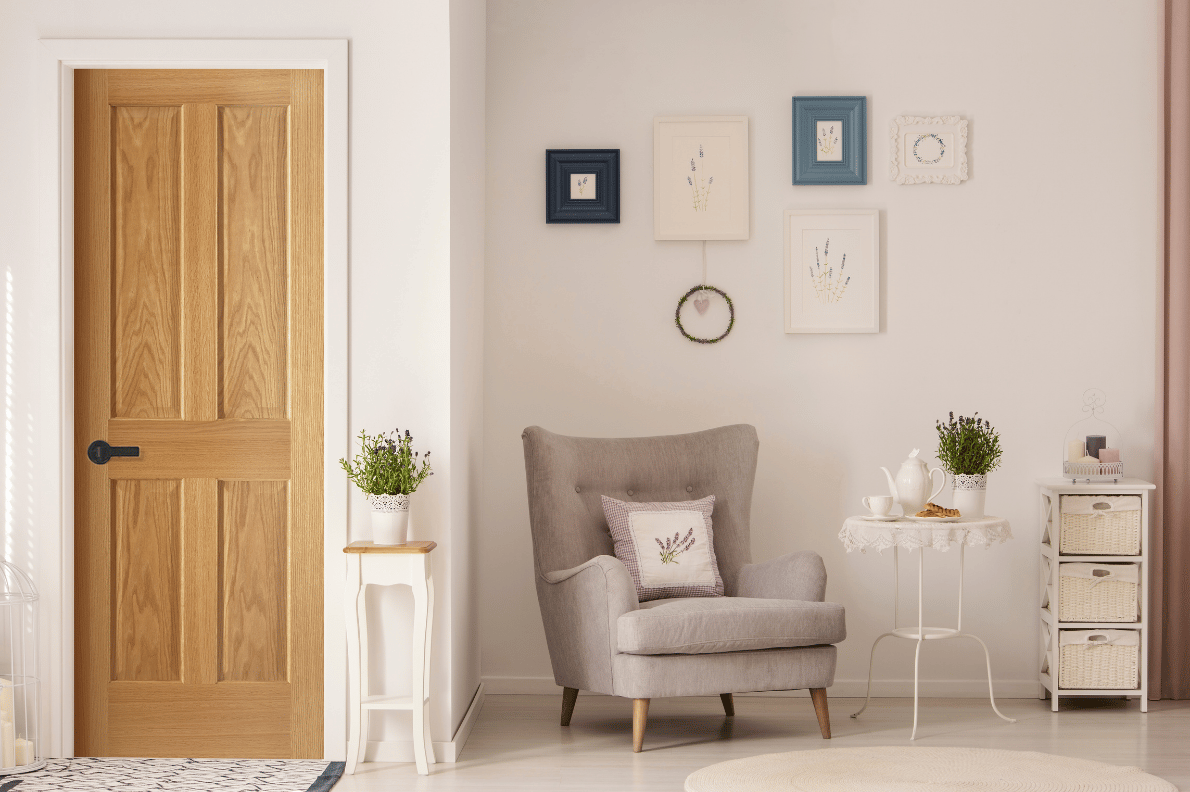
Wood interior doors have character. The grain, the weight, the way they hang and close all feel different from engineered options. They can be stained or painted. Staining shows the natural grain, which MDF and molded doors cannot offer. Wood costs more and can be affected by humidity over time, but proper finishing helps. For high-use rooms or homes where woodwork is a design priority, wood interior doors are worth the investment.
Panel style describes how the face of the door is designed. Here is how the main options break down:
Panel count matters too. A 2-panel shaker looks different from a 5-panel shaker. The choice should match the trim and character of the rest of the home.
Sticking profile is the shape cut into the edge of the panels. Square sticking has a clean, right-angle edge, common in shaker doors and modern interiors. Bead and cove sticking has a curved, more detailed profile seen on traditional raised panel doors. Round sticking falls in between.
If you are replacing doors and want them to match existing ones, look at the sticking profile first. Mixing profiles in the same hallway rarely looks intentional.
Standard interior door widths run from 1 foot 6 inches up to 3 feet. Standard heights are 6 feet 8 inches or 8 feet. But not every opening is standard, especially in older homes.
Before ordering anything, measure the rough opening more than once. Width at the top, middle, and bottom. Height on both sides. Old openings can be out of square in ways that matter when fitting a door. If a standard size does not fit, custom sizing adds cost and lead time, so confirm early.
Some locations inside a home require fire-rated doors. The most common example is the door between an attached garage and the living space. Most local building codes require a rated door there. Fire-rated doors are thicker, heavier, and must be solid, not hollow. Check the local code before ordering if your project involves a garage connection or any opening near mechanical equipment.
Doors are part of a system. The casing around each door should line up with the baseboard and window trim. When profiles match, the interior feels pulled together. If you are also ordering trim and moulding for the project, that is a good time to align the profiles. Think about hardware early too. Style should carry through from the door to every detail around it.
The team at The Liquidators Company can help you sort through the options. Whether you know exactly what you need or are still working through the details, stop by the showroom at 501 Carlisle Road in Dawsonville or give us a call at (770) 894-1632.
What is the difference between hollow core and solid core interior doors?
Hollow core doors have a lightweight inside surrounded by a thin shell. They are lighter and cost less. Solid core doors have a dense interior that blocks more sound and feels heavier when you use them. Solid core is worth the extra cost in bedrooms, bathrooms, and home offices where noise and privacy matter.
Are MDF doors a good choice for painted interiors?
Yes. MDF doors are one of the best options for painted finishes. The surface is smooth and even, so paint goes on cleanly without grain showing through. They are also stable in interior conditions, which means less risk of cracking or warping compared to solid wood.
How do I know what size door I need?
Measure the rough opening, not the existing door. Measure width at the top, middle, and bottom. Measure height on both sides. Use the smallest number in each direction. In older homes, openings are often out of square, so this step matters more than most people expect.
Can I use the same door style throughout the whole house?
Yes, and it usually works well. A consistent door style gives the home a cleaner, more intentional look. Where variation makes more sense is in function, such as solid core for bedrooms and hollow core for closets, not necessarily in style.
Do interior doors need to match the exterior doors?
No. Interior and exterior doors serve different purposes and are made from different materials. What matters more is that interior doors stay consistent with each other and with the overall trim style of the home.